
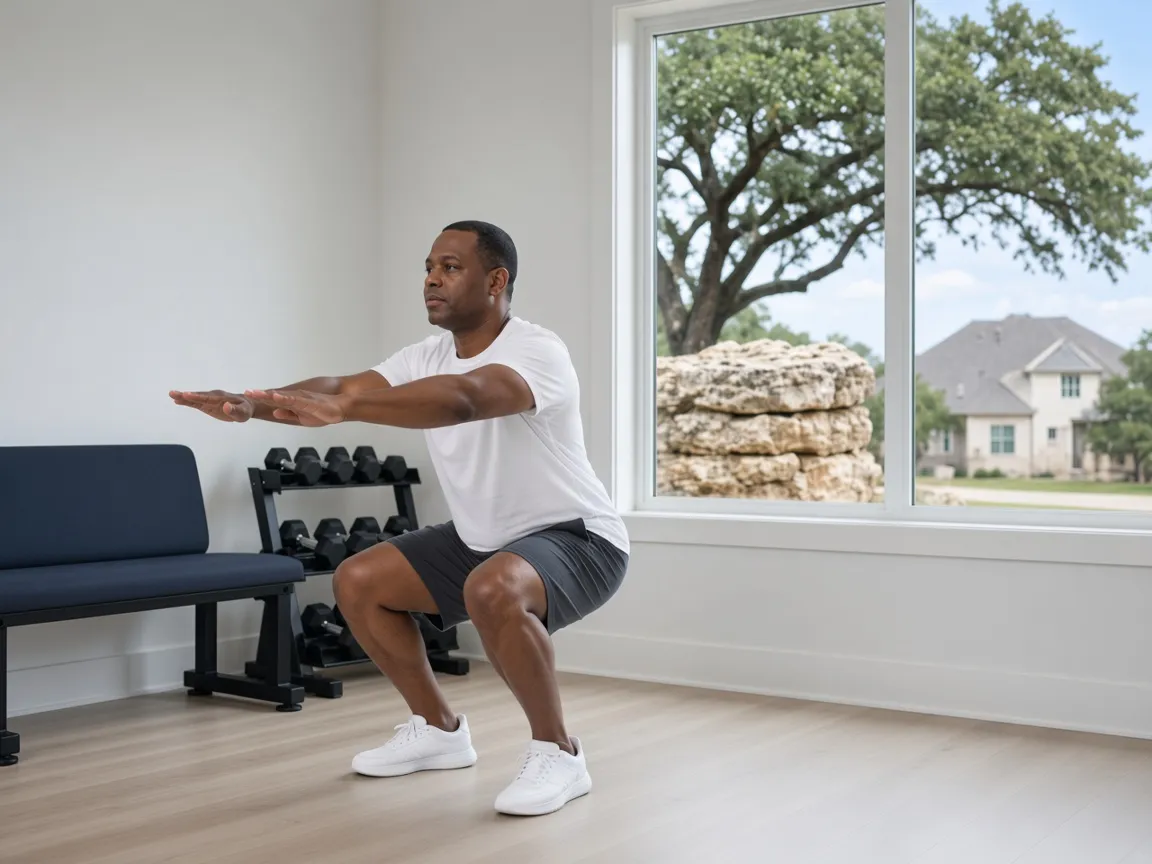
Strength and aging
Why muscle matters after 40: strength, aging, and longevity
Muscle and strength usually peak by about age 40, then tend to slip.
What you'll learn
- How sarcopenia is defined.
- What human studies show about survival, strength work, and function.
When muscle and strength usually change
Muscle mass and strength do not keep climbing. The European consensus on sarcopenia places the usual high point in young adulthood, up to about age 40. After 50, losses of 1-2% of leg muscle mass a year, and 1.5-5% of strength a year, have been reported. The scale can stay still while strength changes.
What sarcopenia means
Sarcopenia is the name for that kind of muscle failure. In the 2019 consensus, it is probable when strength is low, confirmed when muscle quantity or quality is also low, and severe when physical performance has fallen as well. It is more common late in life, and it can begin earlier. The practical question is whether standing up, carrying a bag, or climbing stairs is getting harder.
What a survival study can show
One national survey looked at muscle and survival together. Researchers followed 3,659 adults in NHANES III, men 55 and older and women 65 and older, and compared quarters of muscle mass for height. The highest quarter had a lower adjusted risk of death than the lowest (risk ratio 0.81; 95% CI 0.71-0.91). Muscle was estimated by bioelectrical impedance. Underweight adults and deaths in the first two years were excluded.
What strength training is associated with
A 2022 review asked a different question: what muscle-strengthening activity is associated with, apart from how much muscle someone has. Pooling prospective cohorts, it found a 10-17% lower risk of death from any cause, cardiovascular disease, total cancer, and diabetes, independent of aerobic activity. For death from any cause, the pooled risk ratio was 0.85. The largest reduction sat near 30-60 minutes a week, the curve was J-shaped so more was not clearly better, and the studies were cohorts with results that did not agree closely, not trials that assigned people to lift.
What training trials have shown in older adults
Training trials answer a narrower question. A Cochrane review of 121 randomized trials, about 6,700 older adults, found a large gain in strength from progressive resistance work, usually two or three days a week. Walking speed and rising from a chair improved by less. Serious harms were rarely reported, though soreness and joint pain were common where they were tracked, and many trials tracked them poorly.
What public guidelines recommend
Public advice is more modest than a longevity claim. The Physical Activity Guidelines for Americans say adults should strengthen all major muscle groups on two or more days a week, along with aerobic activity.
| Kind | What it shows | What it does not show |
|---|---|---|
| Definition | The 2019 European consensus: low strength, then low muscle quantity or quality, then poor physical performance. | A schedule for any one person. |
| Association | In observational studies, more muscle or more strengthening activity lined up with a lower risk of death. | Proof that gaining muscle, or a product, extends life. |
| Trial | In older adults, progressive resistance training raised strength. Walking speed and chair stands improved by less. | An effect on lifespan, or the same result at age 40. |
New weakness, a fall, or unintended weight loss belongs with a clinician.
A medical weight-loss visit is a different subject. What a medical weight-loss program involves explains how activity sits beside clinical care. If hormones are part of the question, why hormone therapy starts with lab work explains why a visit uses history and labs. How a clinician evaluation works describes the visit. A licensed provider decides whether any evaluation is appropriate.
Sources
- Cruz-Jentoft AJ, Bahat G, Bauer J, et al. Sarcopenia: revised European consensus on definition and diagnosis. Age and Ageing. January 2019.
- Srikanthan P, Karlamangla AS. Muscle Mass Index as a Predictor of Longevity in Older Adults. The American Journal of Medicine. June 2014.
- Momma H, Kawakami R, Honda T, Sawada SS. Muscle-strengthening activities are associated with lower risk and mortality in major non-communicable diseases: a systematic review and meta-analysis of cohort studies. British Journal of Sports Medicine. 2022.
- Liu CJ, Latham NK. Progressive resistance strength training for improving physical function in older adults. Cochrane Database of Systematic Reviews. July 8, 2009.
- U.S. Department of Health and Human Services. Physical Activity Guidelines for Americans, 2nd edition. 2018.
· . Educational content from Intrinsic Longevity. Clinical decisions are made by licensed providers.
What a medical weight-loss program involves
New weakness, a fall, or unintended weight loss belongs with a clinician. A medical weight-loss visit is a separate question from strength after 40.
Payment does not guarantee that a prescription will be issued or that medication will be dispensed. A licensed clinician decides whether a prescription is appropriate. Intrinsic Longevity does not manufacture compounded medications.